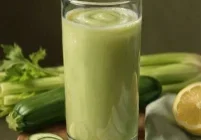
Zucchini, celery and cucumber smoothie

Step 0
A clean, refreshing green smoothie built from zucchini, cucumber, celery, apple, and a small wedge of lemon. Everything goes in unpeeled, so you keep more fiber and micronutrients. Blend to smooth, then adjust thickness with a little extra water if needed.
Texture tip:
Start with 100 ml water. Add a little more only if you want it thinner.
Step 1
Ingredients for zucchini, cucumber and celery smoothie
- Zucchini, raw 150 g
- Cucumber, raw, with peel 150 g
- Celery, raw 1 large stalk (64 g)
- Apple, raw, with skin 1 medium (182 g)
- Lemon, raw 1 wedge (1/8 of a medium, 7 g)
- Water 100 ml (100 g)
Note:
This recipe is designed to be blended unpeeled, including the lemon wedge, for extra fiber and a brighter flavor.
Step 2
How to make the smoothie
- Wash everything. Rinse zucchini, cucumber, celery, apple, and the lemon wedge well. You are using them unpeeled.
- Prep for blending. Slice zucchini, cucumber, and celery into chunks. Remove the apple stem, then cut the apple into quarters.
- Load the blender. Add all produce plus the lemon wedge to the blender. Pour in 100 ml water.
- Blend. Blend for about 1 minute until smooth.
- Adjust thickness. If it is too thick, add a small splash of water and blend again for 10–15 seconds.
- Serve. Pour and drink immediately for the freshest taste.
Storage:
Best fresh. If needed, refrigerate up to 24 hours in a sealed bottle and shake hard before drinking.
Step 3
Health-oriented chef cues
- Hydration-first, low calorie. Per 100 g, this smoothie is very light (about 23 kcal) and water-rich, so it can be a good “volume” drink when you want something fresh without a big calorie hit.
- Keep the peels. Using cucumber and apple with skin helps preserve fiber and a chunk of the micronutrient content that often sits near the peel.
- Fiber helps pace appetite. This sits around 1.35 g fiber per 100 g. If you drink it slowly, it can support satiety better than fruit juice.
- Protein upgrade option. Replace some or all of the water with high-protein skyr, kefir, or (Greek) yogurt. You get extra protein and micronutrients, but the smoothie becomes thicker, so you may need to blend longer or add a small splash of water.
- Citrus lever. The lemon wedge brightens flavor and can make a low-sugar smoothie taste sweeter than it is, which helps if you are trying to keep sugars modest.
- Make it more filling without many calories. If you want more satiety without changing flavor much, increase cucumber or zucchini volume first, instead of adding more fruit.
Note:
If you swap water for skyr, kefir, or yogurt, the nutrition values shown later will no longer be exact.
Nutrition facts and macros
Macros & Calories
per 100 g
Calories
23.4 kcal
- Saturates: 0.05 g
- Sugars: 4.02 g
- Fiber: 1.35 g
- Salt: 0.00 g
See full macronutrient table (per 100 g)
| Nutrient | Amount | % RI |
|---|---|---|
| Energy | 98.10 kJ / 23.43 kcal | |
| Fat | 0.18 g | |
| Saturated | 0.05 g | |
| Monounsaturated | <0.01 g | |
| Polyunsaturated | 0.06 g | |
| Carbohydrate | 5.68 g | |
| Sugars | 4.02 g | |
| Starch | 0.05 g | |
| Fiber | 1.35 g | |
| Protein | 0.55 g | |
| Salt | 0.00 g | |
| Sodium | 12.75 mg |
Carbohydrates breakdown
| Nutrient | Amount | % RI |
|---|---|---|
| Total Carbs | 5.68 g | |
| Fiber | 1.35 g | |
| Starch | 0.05 g | |
| Sugars | 4.02 g | |
| Fructose | 2.21 g | |
| Glucose | 1.15 g | |
| Sucrose | 0.61 g | |
| Galactose | 0.05 g | |
| Lactose | 0.00 g | |
| Maltose | <0.01 g | |
| Added Sugars | 0.00 g | |
| Sugar Alcohol | 0.09 g | |
| Net Carbs | 4.24 g |
Fat (lipids) breakdown
| Nutrient | Amount | % RI |
|---|---|---|
| Fat | 0.18 g | |
| Monounsaturated | <0.01 g | |
| Polyunsaturated | 0.06 g | |
| Omega-3 | 0.02 g | |
| Omega-6 | 0.03 g | |
| Saturated | 0.05 g | |
| Trans-Fats | 0.00 g | |
| Cholesterol | 0.00 mg | |
| Phytosterol | 3.36 mg |
Protein (amino acid) breakdown
| Amino acid | Amount | % RI |
|---|---|---|
| Protein | 0.55 g | |
| Alanine | 0.03 g | |
| Arginine | 0.03 g | |
| Aspartic acid | 0.08 g | |
| Cystine | <0.01 g | |
| Glutamic acid | 0.09 g | |
| Glycine | 0.02 g | |
| Histidine | 0.01 g | |
| Isoleucine | 0.02 g | |
| Leucine | 0.03 g | |
| Lysine | 0.03 g | |
| Methionine | <0.01 g | |
| Phenylalanine | 0.02 g | |
| Proline | 0.02 g | |
| Serine | 0.02 g | |
| Threonine | 0.01 g | |
| Tryptophan | <0.01 g | |
| Tyrosine | 0.01 g | |
| Valine | 0.02 g |
Key Micronutrients
top 15 by % RI, per 100 g
See full micronutrient table (per 100 g)
| Nutrient | Amount | % RI |
|---|---|---|
| Vitamin C | 6.89 mg | |
| Vitamin A | 6.56 µg | |
| Vitamin D | 0.00 IU (≈0.00 µg) | |
| Vitamin E | 0.11 mg | |
| Vitamin K | 9.94 µg | |
| B1 (Thiamine) | 0.02 mg | |
| B2 (Riboflavin) | 0.04 mg | |
| B3 (Niacin) | 0.18 mg | |
| B5 (Pantothenic Acid) | 0.15 mg | |
| B6 (Pyridoxine) | 0.06 mg | |
| Vitamin B12 | 0.00 µg | |
| Choline | 5.15 mg | |
| Folate | 11.59 µg | |
| Calcium | 14.26 mg | |
| Iron | 0.12 mg | |
| Magnesium | 9.12 mg | |
| Phosphorus | 19.36 mg | |
| Potassium | 156.01 mg | |
| Zinc | 0.14 mg | |
| Copper | 0.04 mg | |
| Manganese | 0.08 mg | |
| Selenium | 0.12 µg | |
| Iodine | 0.16 µg | |
| Fluoride | 0.92 µg | |
| Sodium | 12.75 mg |
Step-by-step instructions
Wash all produce thoroughly. Cut zucchini, cucumber, celery, and apple into chunks. Add everything to a blender with water, blend until smooth, and adjust thickness if needed. Serve immediately.
Smoothie FAQs
- Can I replace the water?
- Yes. You can replace part or all of the water with high-protein skyr, kefir, or yogurt for extra protein and micronutrients. The smoothie will be thicker, so you may need to blend longer or add a small splash of water.
- Is this smoothie good for weight loss?
- It is very low in calories per 100 g and high in volume. It can help with fullness, especially when paired with a protein source.