Actually Delicious Protein Pancakes

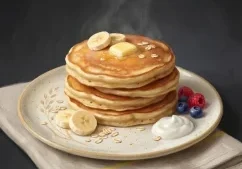
These protein pancakes are built for real-world consistency: oats for structure, eggs for richness, cottage cheese for protein, and banana for sweetness and texture. Everything goes into the blender, then you cook small pancakes until golden. Finish with simple toppings if you want the full “weekend breakfast” feel without the chaos.
Ingredients for protein pancakes
- Rolled oats, dry 100 g
- Eggs, raw 2 large (100 g)
- Cottage cheese, lowfat 2% 100 g
- Banana, ripe 1 large (136 g)
- Baking powder 2 g
- Unsweetened almond milk 1 oz (28.3 g)
- Sunflower oil (for the pan) 1 tbsp (13.6 g)
How to make the pancakes
- Blend the batter. Add oats, eggs, cottage cheese, banana, baking powder, and almond milk to a blender. Blend until smooth. If it is too thick to pour, add a small extra splash of almond milk.
- Prepare the toppings (optional). If you are using toppings, get them ready now so you can serve immediately once the pancakes are done.
- Heat the pan and control the oil. Heat a non-stick frying pan over medium heat. Brush with oil, then pour out any excess so the pan is only lightly coated.
- Cook the pancakes. Drop heaped tablespoons of batter into the pan. Cook for 3 min, or until bubbles form on top. Flip carefully and cook for another 2 to 3 min, until lightly golden and cooked through.
- Serve. Stack and serve immediately. If you want the “dessert breakfast” vibe, add yoghurt, fruit, and a drizzle of honey.
Health-oriented chef cues
- Protein and structure: Per 100 g, these pancakes provide 7.85 g protein. Cottage cheese plus eggs helps them feel more “meal-like” than typical pancakes.
- Energy density is controllable: The biggest lever is the pan oil and toppings. Keep oil truly “brush-thin,” and portion sweet toppings if you are chasing a lighter breakfast.
- Fiber for steadier hunger: Oats plus banana contribute 2.65 g fiber per 100 g. That tends to help satiety compared with flour-only pancakes.
- Micronutrient sneaky win: Per 100 g, you get meaningful minerals like phosphorus (164.85 mg) and selenium (14.83 µg), which supports basic energy metabolism and antioxidant systems.
Nutrition facts and macros
Macros & Calories
per 100 g
- Saturates: 1.50 g
- Sugars: 5.76 g
- Fiber: 2.65 g
- Salt: 0.30 g
See full macronutrient table (per 100 g)
| Nutrient | Amount | % RI |
|---|---|---|
| Energy | 752.30 kJ / 179.68 kcal | |
| Fat | 6.90 g | |
| Saturated | 1.50 g | |
| Monounsaturated | 1.98 g | |
| Polyunsaturated | 2.69 g | |
| Carbohydrate | 22.18 g | |
| Sugars | 5.76 g | |
| Starch | 12.37 g | |
| Fiber | 2.65 g | |
| Protein | 7.85 g | |
| Salt | 0.30 g | |
| Sodium | 137.93 mg |
Carbohydrates breakdown
| Nutrient | Amount | % RI |
|---|---|---|
| Total Carbs | 22.18 g | |
| Fiber | 2.65 g | |
| Starch | 12.37 g | |
| Sugars | 5.76 g | |
| Fructose | 1.73 g | |
| Galactose | 0.03 g | |
| Glucose | 1.81 g | |
| Lactose | 0.81 g | |
| Maltose | 0.00 g | |
| Sucrose | 1.39 g | |
| Added Sugars | 0.00 g | |
| Sugar Alcohol | <0.01 g | |
| Net Carbs | 19.53 g |
Fat (lipids) breakdown
| Nutrient | Amount | % RI |
|---|---|---|
| Fat | 6.90 g | |
| Monounsaturated | 1.98 g | |
| Polyunsaturated | 2.69 g | |
| Omega-3 | 0.04 g | |
| Omega-6 | 2.64 g | |
| Saturated | 1.50 g | |
| Trans-Fats | 0.03 g | |
| Cholesterol | 80.21 mg |
Protein (amino acid) breakdown
| Amino acid | Amount | % RI |
|---|---|---|
| Protein | 7.85 g | |
| Alanine | 0.36 g | |
| Arginine | 0.44 g | |
| Aspartic acid | 0.75 g | |
| Cystine | 0.17 g | |
| Glutamic acid | 1.48 g | |
| Glycine | 0.27 g | |
| Histidine | 0.20 g | |
| Isoleucine | 0.37 g | |
| Leucine | 0.66 g | |
| Lysine | 0.51 g | |
| Methionine | 0.18 g | |
| Phenylalanine | 0.40 g | |
| Proline | 0.45 g | |
| Serine | 0.48 g | |
| Threonine | 0.31 g | |
| Tryptophan | 0.10 g | |
| Tyrosine | 0.31 g | |
| Valine | 0.46 g |
Key Micronutrients
top 15 by % RI, per 100 g
See full micronutrient table (per 100 g)
| Nutrient | Amount | % RI |
|---|---|---|
| B1 (Thiamine) | 0.12 mg | |
| B2 (Riboflavin) | 0.19 mg | |
| B3 (Niacin) | 0.43 mg | |
| B5 (Pantothenic Acid) | 0.73 mg | |
| B6 (Pyridoxine) | 0.12 mg | |
| Vitamin B12 | 0.35 µg | |
| Biotin | 2.89 µg | |
| Choline | 75.99 mg | |
| Folate | 21.47 µg | |
| Vitamin A | 48.08 µg | |
| Vitamin C | 3.49 mg | |
| Vitamin D | 20.32 IU (≈0.51 µg) | |
| Vitamin E | 1.72 mg | |
| Vitamin K | 0.66 µg | |
| Calcium | 79.25 mg | |
| Copper | 0.13 mg | |
| Iodine | 17.65 µg | |
| Iron | 1.24 mg | |
| Magnesium | 38.67 mg | |
| Manganese | 0.76 mg | |
| Molybdenum | 20.83 µg | |
| Phosphorus | 164.85 mg | |
| Potassium | 219.50 mg | |
| Selenium | 14.83 µg | |
| Sodium | 137.93 mg | |
| Zinc | 0.95 mg |
Step-by-step instructions
Step 1: Blend the batter
Add oats 100 g, eggs 2 large (100 g), cottage cheese 100 g, banana 136 g, baking powder 2 g, and almond milk 28.3 g to a blender. Blend until smooth. If the batter is too thick to pour, add a small extra splash of almond milk.
Step 2: Heat the pan and prep the oil
Place a non-stick pan on medium heat. Brush the pan with sunflower oil 13.6 g, then pour out any excess. You want a thin film, not a pool.
Step 3: Cook the pancakes
Spoon heaped tablespoons of batter into the pan. Cook for 3 min until bubbles appear on top. Flip carefully and cook for another 2 to 3 min until golden and cooked through. Repeat until the batter is finished.
Step 4: Serve immediately
Stack and serve right away for best texture. Add toppings if you want, but remember toppings are not included in the nutrition values shown in this post.
Protein pancakes FAQs
- Can I make the batter ahead?
- You can, but it thickens in the fridge. Blend again or loosen with a small splash of almond milk before cooking.
- Why cottage cheese?
- It boosts protein and helps texture. When blended, it disappears into the batter and keeps the pancakes tender.
- How do I keep them from sticking?
- Use a non-stick pan, keep heat at medium, and brush oil thinly. Flip only once bubbles show on top.
- Can I freeze them?
- Yes. Freeze in a single layer first, then store sealed. Reheat gently so they do not dry out.