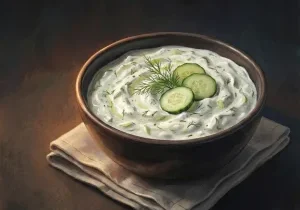
Tzatziki

Step 0
A simple tzatziki that tastes like summer even when it is cold outside. The trick is all in the cucumber: grate it fine, squeeze out the water, and the dip turns thick and restaurant-clean. Use it as a dip, a sauce for bowls, or a high-protein “spread” that makes a basic meal feel finished.
Step 1
Ingredients for tzatziki
- Greek yoghurt 1 cup (250 g)
- Cucumber, grated and squeezed 1 large (301 g)
- Garlic, very finely minced 1 clove (3 g)
- Fresh dill 3 tbsp (1.7 g)
- Salt 1 tsp (≈6 g) (add to taste)
Serving ideas:
Use it with high-fiber bread, knäckebröd, roasted potatoes, grilled veggies, bowls, wraps, or as a sauce for lean protein.
Step 2
How to make tzatziki
- Start with the yogurt. Add Greek yoghurt to a bowl.
- Grate and squeeze. Grate the cucumber into fine pieces. Transfer to a cheesecloth or clean towel and squeeze hard to remove as much moisture as possible.
- Salt the cucumber. Put the cucumber back in a small bowl, add salt, mix, and let it rest 2–5 min. Squeeze once more if water shows up.
- Build the flavor. Mince the garlic very finely and stir it into the yogurt.
- Combine and finish. Add the squeezed cucumber and dill to the yogurt. Mix well. Taste and adjust salt.
Storage:
Refrigerate in a sealed container up to 2–3 days.
If it releases liquid, stir and taste again before serving.
Step 3
Health-oriented chef cues
- Thickness is a health tool: squeezing the cucumber keeps the dip thick, so you use it as a real sauce instead of drowning food in extra oil-based dressings.
- Protein upgrade, same vibe: for higher protein, swap part of the yogurt for skyr, quark/kwark, or cottage cheese (or mix them). You keep the creamy feel while increasing satiety.
- Volume without calories: using 2–4 cucumbers makes a bigger, fresher bowl with minimal extra calories, great for meal prep or snack plates.
- Salt is the knob to turn: tzatziki needs salt to taste “right,” but you can still win by adding it gradually, letting it sit, then tasting again before adding more.
- Pair it for a full meal: combine tzatziki with fiber (whole-grain bread, veggies) and a protein source (beans, tofu, chicken, eggs) to keep cravings down and meals steady.
Note:
Nutrition values below are calculated per 100 g for the tzatziki recipe as listed.
If you switch to skyr, quark, or cottage cheese, macros and micros will change.
Nutrition facts and macros
Macros & Calories
per 100 g
Calories
50.6 kcal
- Saturates: 1.1 g
- Sugars: 2.4 g
- Fiber: 0.6 g
- Salt: 1.1 g
See full macronutrient table (per 100 g)
| Nutrient | Amount | % RI |
|---|---|---|
| Energy | 211.9 kJ / 50.6 kcal | |
| Fat | 2.1 g | |
| Saturated | 1.1 g | |
| Monounsaturated | 0.4 g | |
| Polyunsaturated | 0.1 g | |
| Carbohydrate | 3.3 g | |
| Sugars | 2.4 g | |
| Starches | 0.2 g | |
| Fibre | 0.6 g | |
| Protein | 4.3 g | |
| Salt | 1.10 g | |
| Sodium | 435.56 mg |
Carbohydrates breakdown
| Nutrient | Amount | % RI |
|---|---|---|
| Total Carbs | 3.91 g | |
| Fiber | 0.64 g | |
| Starch | 0.20 g | |
| Sugars | 2.39 g | |
| Fructose | 0.48 g | |
| Galactose | 0.29 g | |
| Glucose | 0.42 g | |
| Lactose | 1.17 g | |
| Maltose | <0.01 g | |
| Sucrose | 0.02 g | |
| Added Sugars | 0.00 g | |
| Sugar Alcohol | 0.06 g | |
| Net Carbs | 3.21 g |
Fat (lipids) breakdown
| Nutrient | Amount | % RI |
|---|---|---|
| Fat | 2.08 g | |
| Monounsaturated | 0.44 g | |
| Polyunsaturated | 0.10 g | |
| Omega-3 | 0.01 g | |
| Omega-6 | 0.08 g | |
| Saturated | 1.11 g | |
| Trans-Fats | 0.07 g | |
| Cholesterol | 7.65 mg |
Protein (amino acid) breakdown
| Amino acid | Amount | % RI |
|---|---|---|
| Protein | 4.34 g | |
| Alanine | 0.17 g | |
| Arginine | 0.15 g | |
| Aspartic acid | 0.39 g | |
| Cystine | 0.06 g | |
| Glutamic acid | 0.91 g | |
| Glycine | 0.09 g | |
| Histidine | 0.10 g | |
| Isoleucine | 0.21 g | |
| Leucine | 0.40 g | |
| Lysine | 0.37 g | |
| Methionine | 0.09 g | |
| Phenylalanine | 0.17 g | |
| Proline | 0.31 g | |
| Serine | 0.21 g | |
| Threonine | 0.21 g | |
| Tryptophan | 0.07 g | |
| Tyrosine | 0.14 g | |
| Valine | 0.23 g |
Key Micronutrients
top 15 by % RI, per 100 g
See full micronutrient table (per 100 g)
| Nutrient | Amount | % RI |
|---|---|---|
| Vitamin A | 21.35 µg | |
| Vitamin C | 1.83 mg | |
| Vitamin D | 0.00 IU (≈0.00 µg) | |
| Vitamin E | 0.04 mg | |
| Vitamin K | 13.94 µg | |
| B1 (Thiamine) | 0.04 mg | |
| B2 (Riboflavin) | 0.13 mg | |
| B3 (Niacin) | 0.16 mg | |
| B5 (Pantothenic Acid) | 0.31 mg | |
| B6 (Pyridoxine) | 0.05 mg | |
| Vitamin B12 | 0.25 µg | |
| Choline | 11.50 mg | |
| Folate | 4.26 µg | |
| Calcium | 60.21 mg | |
| Iron | 0.03 mg | |
| Magnesium | 10.67 mg | |
| Phosphorus | 70.17 mg | |
| Potassium | 162.60 mg | |
| Zinc | 0.33 mg | |
| Copper | 0.04 mg | |
| Manganese | 0.06 mg | |
| Selenium | 1.21 µg | |
| Iodine | - | |
| Sodium | 435.56 mg | |
| Salt | 1.10 g |
Step-by-step instructions
Step 1: Prep the cucumber
Grate 1 large cucumber into fine pieces. Squeeze it hard in a towel or cheesecloth to remove moisture. Mix with 1 tsp salt and rest 2–5 min, then squeeze again if needed.
Step 2: Build the base
Put 250 g Greek yoghurt in a bowl. Mince 1 clove garlic very finely and stir it in.
Step 3: Combine and chill
Mix in the squeezed cucumber and 1.7 g dill. Taste, adjust salt, then chill for 10 min for a cleaner flavor.
Tzatziki FAQs
- Why does my tzatziki turn watery?
- The cucumber was not squeezed enough. Grate fine, squeeze hard, salt it, rest 2–5 min, then squeeze again.
- Can I make it higher protein?
- Yes. Replace part of the Greek yoghurt with skyr, quark/kwark, or cottage cheese. It stays creamy but becomes more filling.
- How long does it keep in the fridge?
- About 2–3 days. If liquid separates, stir and taste again before serving.
- What should I eat it with if I want it to be filling?
- Pair it with fiber (whole-grain bread, veggies, knäckebröd) and a protein source (beans, tofu, eggs, chicken) for a more complete meal.